
Dinosauria
This reference covers 328 non-avian dinosaur genera spanning the Mesozoic Era (252–66 million years ago). The catalogue includes every genus currently listed in the Natural History Museum London's Dino Directory, supplemented with curated stratigraphic, paleogeographic and phylogenetic context. Each entry includes the available geological period, temporal range, diet, locomotion, measurements, discovery locations and sourced key facts.
Dinosauria is a free, open-access scientific reference built on the principle that knowledge about natural history should be freely available to everyone. All species data is sourced from the Natural History Museum London's Dinosaur Directory and peer-reviewed literature. The project is part of a broader commitment to open science and public education — making the fossil record accessible to all.
Use the views below to jump straight into the collection — the Taxonomic Catalogue covers the full dataset of 328 genera, Ancient Earth lets you browse species and paleogeographic maps by geological period, Chronostratigraphy, Palaeobiogeography and Phylogenetic Tree present that same dataset by time, place and relationships, and the Field Guide defines the key terms used throughout. The Scientific Context and Collection at a Glance sections further down explain what a dinosaur is, how geological time works, and summarise the dataset itself.
Species facts sourced from the NHM London Dinosaur Directory. Occurrence, stratigraphic and taxonomy enrichment from the Paleobiology Database. Geological context from the International Geological Time Scale (IUGS). Images from Wikimedia Commons (Creative Commons licences). Paleogeographic maps: PALEOMAP Project, Scotese et al., CC BY 4.0.
Ready to explore? Use the views below to navigate the full collection of 328 genera.
The word. "Dinosaur" comes from the Greek deinos (terrible/fearfully great) and sauros (lizard). The name was coined in 1842 by the British anatomist Sir Richard Owen, who recognised that three English fossils — Megalosaurus, Iguanodon and Hylaeosaurus — shared distinctive features unlike any living reptile and formed their own distinct group.
When were they discovered? Megalosaurus was the first dinosaur formally described (Buckland, 1824), followed by Iguanodon (Mantell, 1825), both from England. Most early research was European and North American. Global fieldwork accelerated in the 20th century and new dinosaur genera are still being described at roughly 40–50 per year.
What defines a dinosaur? Not size — a chicken and a Brachiosaurus are both dinosaurs. Dinosauria is defined by shared ancestry: it includes the most recent common ancestor of Triceratops and the house sparrow, and everything descended from that ancestor. Anatomically, the key diagnostic features include an open hip socket (perforate acetabulum) and hindlimbs held directly beneath the body rather than sprawling sideways (see Figure A below).
Why do dinosaurs matter? Dinosaurs dominated land ecosystems for about 165 million years — more than 500 times longer than modern humans have existed. They shaped terrestrial ecology on every continent, drove the evolution of flowering plants, and their extinction 66 million years ago opened the ecological space that allowed mammals (and eventually us) to diversify.
Birds are the only living dinosaurs. This is a scientific fact, not a metaphor. Birds (Aves) are theropod dinosaurs — they sit within Maniraptora, within Theropoda, within Saurischia, within Dinosauria (see Figure B below). The mass extinction 66 million years ago wiped out all non-avian dinosaurs; the bird lineage survived and diversified into the approximately 10,500 species alive today. Every bird you see is a living dinosaur.
- Dinosauria includes the last common ancestor of Triceratops, modern birds and all descendants.
- Birds are living theropod dinosaurs — the K–Pg extinction ended non-avian dinosaurs, not the lineage.
- Pterosaurs and crocodilians are archosaurs but lie outside Dinosauria.
- A perforate acetabulum (open hip socket) is one of the classic skeletal synapomorphies.
- Hindlimbs are held directly beneath the body — unlike the sprawling posture of lizards.
- Erect stance changes locomotion: the body is supported from below, enabling efficient running.


Putting dinosaurs in perspective. Earth is 4.54 billion years old. The entire age of dinosaurs — the Mesozoic Era — represents just 4.1% of that history. The geo-scale below compresses Earth's full timeline into a single view, with the Mesozoic highlighted. It is a useful corrective: dinosaurs feel ancient to us, but relative to the planet's age, they are a recent episode.
What preceded the Mesozoic. The Mesozoic did not begin in a thriving world. It opened in the aftermath of the end-Permian mass extinction (252 Ma) — the most severe biotic crisis in Earth's history, which eliminated over 90% of marine species and 70% of terrestrial vertebrate species. It was this catastrophic ecological reset that cleared the stage for dinosaurs to eventually rise. Without the Permian extinction, the Mesozoic world would have looked entirely different.
Origins. Dinosaurs evolved from small, bipedal archosaurs in what is now South America around 231–243 Ma (Late Triassic). The earliest known dinosaurs — including Eoraptor and Herrerasaurus from Argentina — were modest in size, typically under 1 metre, and were rare components of ecosystems dominated by other archosaurs and synapsids. There was nothing inevitable about their eventual dominance.
The trigger: the end-Triassic extinction. Around 201 Ma, a massive volcanic event (the Central Atlantic Magmatic Province) caused a global extinction that wiped out most of the competing large vertebrates. Dinosaurs survived and, with their ecological rivals gone, radiated explosively into the vacant niches. Within a few million years they were the dominant large terrestrial vertebrates on every continent — a position they held for the next 135 million years.
What made them so successful? Several key innovations gave dinosaurs an edge: an erect posture (limbs beneath the body rather than sprawling) enabled efficient locomotion and large body sizes; evidence from bone microstructure shows many lineages had rapid, sustained growth rates unlike most other reptiles; and their respiratory system — with air sacs like modern birds — was highly efficient, supporting high activity levels. These traits allowed them to dominate ecosystems from polar forests to tropical lowlands.
Ecological diversity. Over 165 million years, dinosaurs evolved into every major terrestrial ecological role: apex predators (tyrannosaurs, allosaurs), giant herbivores (sauropods reaching 70+ tonnes), armoured grazers (ankylosaurs, stegosaurs), fast cursors (ornithomimosaurs), and ultimately the ancestors of every flying bird. They colonised every continent, including Antarctica, and diversified into an estimated 1,000+ genera over their reign. The size comparison below illustrates the extraordinary body-size range this produced — from crow-sized theropods to the longest animals ever to walk the Earth.
From feathered dinosaurs to birds. Feathers originated within theropod dinosaurs before the appearance of modern birds, initially serving functions including insulation and display before some feather types became adapted for flight. Archaeopteryx, from the Late Jurassic Solnhofen Limestone of Germany, preserves a striking evolutionary mosaic: well-developed flight feathers alongside dinosaurian features such as teeth, clawed fingers and a long bony tail. The Berlin specimen shown below is one of the most complete and scientifically important examples.


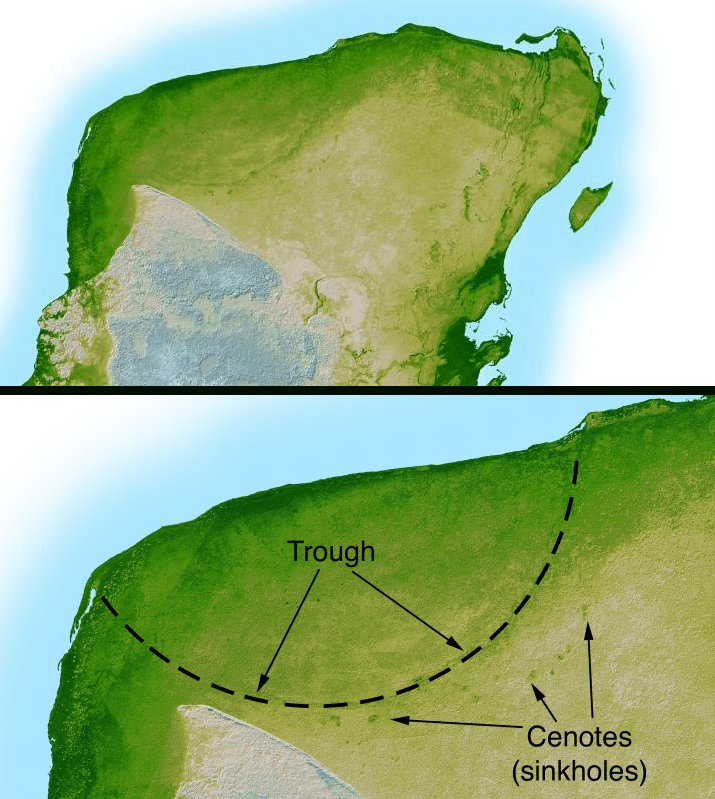
The impact. 66.043 million years ago, an asteroid approximately 10–15 km in diameter struck the Yucatán Peninsula, Mexico — the Chicxulub impact. The 180 km crater it left is now buried beneath 600m of sediment under the Gulf of Mexico, visible only through radar topography (see figure below). The energy released was approximately a billion times that of the Hiroshima bomb. It triggered immediate global wildfires, then a prolonged "impact winter": debris and sulphur aerosols blocked sunlight for months to years, collapsing photosynthesis and the food chains that depended on it.
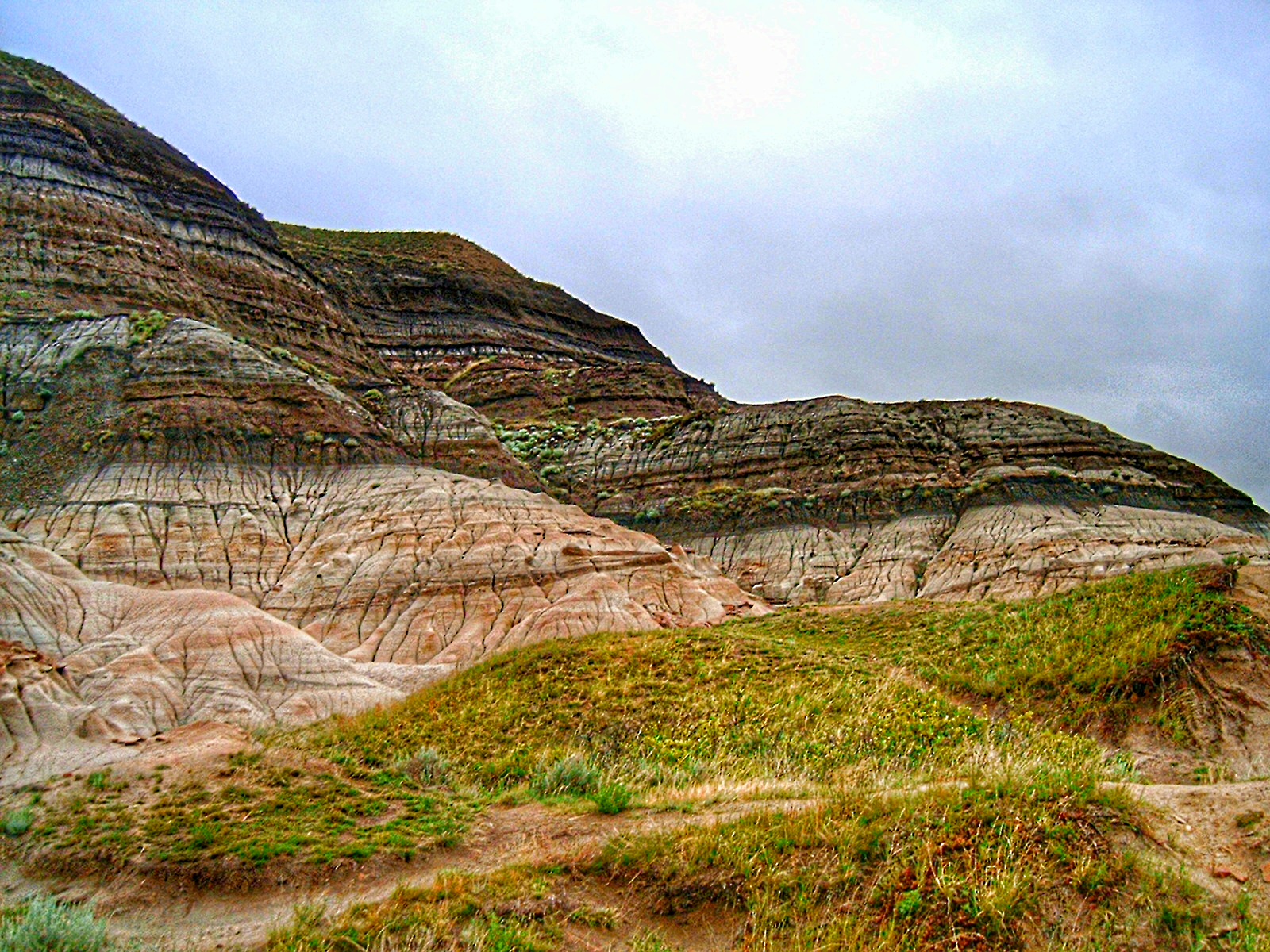
The K–Pg mass extinction. The Cretaceous–Palaeogene (K–Pg) boundary marks one of the five great mass extinctions in Earth history. Approximately 75% of all species went extinct, including all non-avian dinosaurs, marine reptiles (mosasaurs, plesiosaurs), pterosaurs, and the majority of marine invertebrates. The extinction was geologically instantaneous — effectively simultaneous worldwide. This boundary is physically visible in rock outcrops across the globe as a thin layer of iridium-rich clay (see figure below) — one of the clearest markers in the entire geological record.
Why birds survived. The bird lineage (Aves) was the only dinosaur group to survive. Current evidence suggests several factors: birds were small (low energy requirements), many were generalist feeders capable of surviving on seeds and detritus when other food chains collapsed, and their high metabolic rates allowed rapid generational turnover. Within a few million years, surviving bird lineages had diversified into many of the ecological roles vacated by non-avian dinosaurs.
Stages are finer subdivisions of geological periods. They are useful because fossil formations often date to a stage, not just a broad period, so stages let palaeontologists compare rocks and faunas more precisely across regions. Click a stage to open its Wikipedia summary.
Field Guide to Dinosaur Palaeontology
A conceptual guide to the terms, evidence, methods and source caveats needed to read the Dinosauria catalogue scientifically.
Six foundational systems worth reading before treating the catalogue as data. Each one explains a core layer of palaeontology and how it appears elsewhere in the wiki.
Dinosauria is a formal scientific clade, not a colloquial label. It is defined as a node-based clade: the most recent common ancestor of Triceratops horridus and Passer domesticus (the house sparrow), and all their descendants, living and extinct. Because birds (Aves) are nested within Theropoda within Saurischia within Dinosauria, every living bird is unconditionally a dinosaur.
The anatomical diagnosis includes: a perforate acetabulum (open hip socket); hindlimbs held directly beneath the body in an erect posture; a supra-acetabular crest on the ilium; and a fully developed deltopectoral crest on the humerus. These characters distinguish dinosaurs from pterosaurs and crocodilians — closely related archosaurs that lie outside Dinosauria.
A phylogenetic tree (cladogram) is a hypothesis of evolutionary relationships based on shared derived characters. Branch position indicates shared ancestry: taxa sharing a more recent common ancestor appear as closer branches. Cladograms are not ladders of progress — they do not imply a linear sequence, and they do not show that one living group "evolved from" another living group.
Dinosaur names follow the International Code of Zoological Nomenclature (ICZN). Every species carries a binomial — genus (e.g. Tyrannosaurus) and species epithet (e.g. rex) — written in italics. Each name is anchored by a holotype: the physical fossil to which the name is formally attached. Under the Principle of Priority, when two names apply to the same animal, the older name takes precedence.
A period is a major formal division of geological time. The Mesozoic has three: Triassic (252–201 Ma), Jurassic (201–145 Ma) and Cretaceous (145–66 Ma). This wiki uses six informal intervals — Late Triassic, Early Jurassic, Mid Jurassic, Late Jurassic, Early Cretaceous and Late Cretaceous — which reflect the labels used by the NHM Dino Directory.
A stage is a formal subdivision of a period, defined by the International Commission on Stratigraphy using characteristic fossil assemblages and radiometric dates. Examples: Maastrichtian, Campanian (Late Cretaceous); Kimmeridgian, Tithonian (Late Jurassic). Stages allow fossil sites from different continents to be compared precisely.
A formation is a formally defined body of rock traceable across a geographic area. Key formations in this wiki: Morrison Formation (Late Jurassic, USA — Allosaurus, Stegosaurus, Diplodocus); Yixian Formation (Early Cretaceous, China — feathered theropods); Nemegt Formation (Late Cretaceous, Mongolia — Tarbosaurus, Gallimimus).
Taphonomy covers the full sequence from death to discovery: decay, transport, burial, mineralisation, diagenesis and erosion. Hard mineralised tissues (bone, teeth) preserve far more readily than soft tissues. River-margin, lake-bed and coastal-plain environments produce richer records than upland or forest settings. The fossil record systematically underrepresents small animals, juveniles, arboreal species and organisms from under-explored regions.
The absence of a taxon from a given time interval or region does not mean it was not present — it may mean preservation conditions were unfavourable, or that the rocks have not been collected.
Pangaea was the single supercontinent at the start of the Mesozoic, surrounded by the global ocean Panthalassa. During the Jurassic, it rifted into Laurasia (North America, Europe, Asia) to the north and Gondwana (South America, Africa, India, Australia, Antarctica) to the south. By the Late Cretaceous both landmasses were fragmenting further as the Atlantic actively opened.
These changes profoundly shaped dinosaur evolution. The similarity of Late Jurassic faunas in North America (Morrison Formation) and Tanzania (Tendaguru) reflects their recent shared landmass. Conversely, the independent evolution of abelisaurids (Gondwana's apex predators) and tyrannosaurs (Laurasia's apex predators) is a direct consequence of continental isolation.
Each genus profile is a compact evidence file, not just a fact card. Read the sections together: measurements, taxonomy, fossil localities, preserved material, source quality and uncertainty all constrain what can responsibly be said about the animal.
The searchable dictionary below is organised by scientific domain. Use it as a reference while reading profiles, maps, timelines and cladograms.
The vocabulary of cladistics — the framework Willi Hennig formalised in Phylogenetic Systematics (Hennig, 1966) and which now underpins virtually all dinosaur classification. See cladogram for how to read the trees built with these concepts.
The clade names you'll meet most often when exploring the Phylogenetic Tree — see that view for how they branch from one another. Each is given with its taxonomic authority: the researcher(s) and year that formally erected the name, in the standard academic citation style.
The definitions in this Field Guide draw on standard reference works in vertebrate palaeontology and on the formal codes and frameworks that govern taxonomic and phylogenetic practice. For deeper reading:
- Weishampel, D. B., Dodson, P. & Osmólska, H. (eds.) (2004). The Dinosauria (2nd ed.). University of California Press.
- Benton, M. J. (2014). Vertebrate Palaeontology (4th ed.). Wiley-Blackwell.
- Brusatte, S. L. (2012). Dinosaur Paleobiology. Wiley-Blackwell.
- International Commission on Zoological Nomenclature (1999). International Code of Zoological Nomenclature (4th ed.).
- Hennig, W. (1966). Phylogenetic Systematics. University of Illinois Press.
- Sereno, P. C. (1999). "The evolution of dinosaurs." Science, 284(5423), 2137–2147.
- Natural History Museum, London — Dino Directory (primary data source for this wiki's species records).